

Project completed: P085_Kenya_Uganda
Optimizing Black Soldier Fly Value chain for Sustainable Aquaculture and Food Security in Kenya and Uganda
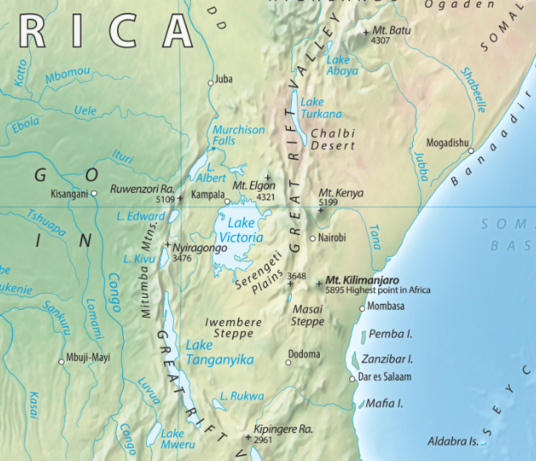
Cooperating countries: Kenya, Uganda and Austria
Coordinating institution: Maseno University, Erick O. Ogello, eogello@maseno.ac.ke
Partner institutions: BOKU University, Busitema University
Project duration: 1 June 2023 - 31 May 2025
Budget: EUR 26.734
Abstract:
With the increasing impacts of climate change on food production systems in East Africa, food and nutrition insecurity is threatening many families, leading to high prevalence of malnutrition, poverty and diseases. This calls for climate-smart propositions with triple wins of 1) increasing food production, 2) enhancing system resilience and 3) ameliorating climate change. Through integrated aquaculture initiatives, this proposal will stimulate an innovative circular economy model that uses Black Soldier Fly (BSF) as a bioreactor to convert organic biowastes into quality proteins (larvae), bio-oil and organic manure. The BSF larvae are alternative source of protein in feed formulation for fish and other animals. Meanwhile, the organic manure is useful for horticulture. This project will produce BSF-based aquafeed for feeding Nile tilapia and catfish. The main input commodity in this initiative is environmental biowastes. The biowastes will be collected from homes, markets, abattoirs, breweries, grain stores etc., by local youth and women. The wastes will be used as substrates to feed BSF larvae in portable crates at backyard homes. Adult BSF will be cultured in cage nets, and eggs collected regularly for hatching and growing into larvae in crates containing biowastes. The BSF larvae will be harvested and used as protein source in processing animal feeds (for fish, chicken and pigs). Organic manure, which is a byproduct, will be harvested for use in horticulture crops. This project supports cottage fish feed industry and intends to solve the problem of fish feed scarcity especially for low-scale fish farmers in local communities.
Summary:
With climate change increasingly threatening food security in East Africa, the project "Optimizing Black Soldier Fly (BSF) Value Chain for Sustainable Aquaculture and Food Security in Kenya and Uganda" (OBSAFS) demonstrated an innovative, climate-smart solution to enhance food production and environmental sustainability. By leveraging the Black Soldier Fly’s ability to convert organic waste into high-quality protein, the project established a circular economy model that not only addressed the critical shortage of affordable fish feed but also created economic opportunities for women and youth while reducing environmental pollution. The project engaged local communities in Kenya and Uganda, particularly women and youth groups, to collect organic waste from markets, abattoirs, breweries, and households. This waste was then used as substrate for rearing BSF larvae in low-cost, portable crates at backyard farms. The process involved breeding adult BSF in cage nets, collecting their eggs, and hatching them into larvae, which were then grown on the biowaste. Once harvested, the protein-rich larvae were processed into animal feed for fish (Nile tilapia and catfish), poultry, and pigs. The residual compost was repurposed as organic fertilizer for horticulture, thereby closing the loop in a zero-waste system. The study addressed the following 3 research questions:
1. How can BSF larvae production be optimized for fish feed formulation to lower the cost of fish feeds in Kenya and Uganda and promote aquaculture production among local communities?
2. What food waste substrates or feed-stalk materials have the best potential to improve BSF reproduction and economic returns?
3. What would be the socio-economic impacts of the BSF value chain among the local communities in Kenya and Uganda?
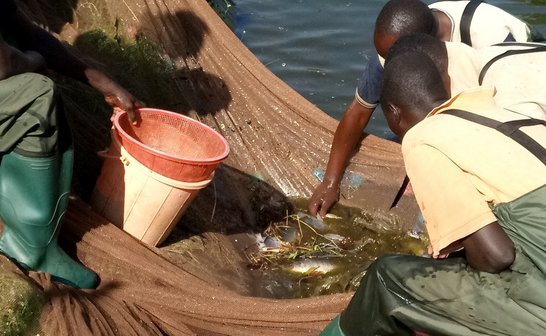
Key outcomes included the recycling of over 500 tons of organic waste (largely market and household wastes), significantly reducing environmental pollution while producing a sustainable alternative to expensive and often imported fishmeal. Small-scale fish farmers reported that BSF-based feeds performed comparably to conventional options but at 30-50% lower cost, making aquaculture more affordable and profitable. Also, chicken farmers reported that chicken fed on BSF larvae were resistant to rampant diseases as opposed to those not fed on BSF larvae. Over 1,200 youth and women were trained in BSF rearing and waste collection, creating new income streams and improving livelihoods. The project also contributed to climate resilience by lowering dependency on resource-intensive fishmeal and reducing greenhouse gas emissions from decomposing organic waste.
To ensure long-term sustainability, the project fostered partnerships with local governments (Mombasa, Kisumu, and Busia Counties in Kenya), research institutions (Maseno University, Kenya Marine and Fisheries Research Institute (KMFRI)), and private sector actors (Hydrovictoria Hatchery Ltd.) to integrate BSF-based feeds into regional aquaculture practices. The success of this initiative highlights the potential for scaling up insect-based feed production across East Africa, offering a replicable model for other regions facing similar food security and waste management challenges. These efforts focus on expanding BSF production hubs, strengthening market linkages, and advocating for supportive policies to mainstream BSF technology in sustainable agriculture and aquaculture systems. By transforming waste into wealth, this project not only improved food security and nutrition but also empowered communities, promoted environmental sustainability, and laid the foundation for a more resilient and circular food economy in Kenya and Uganda.