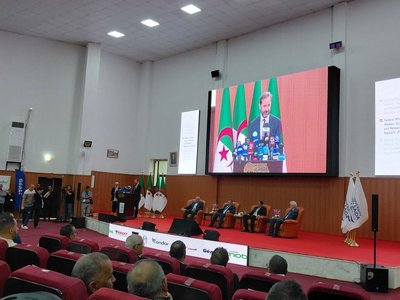
In his welcome address, the Rector of the University of Saida, Prof. Tebboune Fethallah Ouahbi. highlighted the university’s commitment to digital transformation, innovation and research that responds to societal challenges. With more than 12,000 students, eight faculties and 17 research centres, the university sees international cooperation as an important means of strengthening knowledge exchange and contributing to sustainable development. The Rector emphasised that encounters such as the General Assembly can develop into joint research projects, academic exchanges and new initiatives.
The Governor of Saida Province underlined the importance of the General Assembly as a space for exchanging knowledge and experience, strengthening academic and scientific cooperation, and supporting joint research and young researchers. He also highlighted Algeria’s commitment to international and open cooperation in science and higher education.
The Ambassador of Austria to Algeria, Wolfgang Spadinger, placed particular emphasis on the role of Science Diplomacy. In a context marked by international tensions and uncertainty, he stressed the importance of maintaining dialogue and cooperation across borders. Universities and researchers, he noted, can complement diplomatic relations by building connections based on scientific exchange and shared interests. He described Africa-UniNet as an initiative that brings together Austrian and African partners on an equal footing and supports cooperation in areas of mutual relevance.
Africa-UniNet President Hubert Hasenauer highlighted the network’s development since its establishment in 2020. The network now comprises 77 partner institutions, including 44 African institutions from 17 countries, with around 60 projects completed and a further 60 projects currently running. He emphasised the importance of personal encounters in building lasting scientific cooperation and encouraged participants to use the General Assembly to establish new partnerships for future projects.
OeAD Managing Director Jacob Calice described the General Assembly as an important opportunity to strengthen academic collaboration between Austria and institutions across Africa. He emphasised the value of dialogue, mutual understanding and joint projects, particularly in times of uncertainty, and noted Africa-UniNet’s contribution to Austria’s broader strategic engagement with the African continent.
Algeria’s Minister of Higher Education and Scientific Research, Kamel Bidari, who officially opened the 4th Africa-UniNet General Assembly highlighted the role of university cooperation in strengthening relations between Algerian, African and European institutions and pointed to areas including sustainable development, health, food and water security, energy security and digitalisation as important fields for future cooperation.
The opening was followed by the keynote address “Translating Science into Practice: Key Stakeholders’ Agendas within the Science-Policy Interface”, delivered by Dr. Paul T. Yillia from Sierra Leone. Drawing on the relationship between science, policy and practice, he emphasised that research and scientific evidence provide an essential basis for informed decision-making. He stressed that policy and practice should be guided by evidence rather than assumptions, highlighting the importance of translating research findings into practical action. In this context, he underlined the role of researchers and scientific institutions in contributing evidence that can inform policy and address real-world challenges.
Noureddine Halla, Vice-Rector of External Relations of University of Saïda provided a brief introduction to the Algerian higher education system.
While not present in person, Austria’s federal minister for women, science and research, Eva-Maria Holzleitner sent her video message to the General Assembly expressing her appreciation of the Africa-UniNet and highlighting the importance of the network and its shared values such as freedom of research, gender equality, international partnership, scientific exchange on an equal footing and a shared determination to address global challenges.
Science diplomacy and sustainable partnerships at the Africa-UniNet General Assembly
The afternoon programme of the first day of the 4th Africa-UniNet General Assembly focused on the role of science diplomacy and sustainable partnerships in strengthening international cooperation between higher education and research institutions. Bringing together perspectives from Africa and Austria, the session explored how academic cooperation can contribute not only to the exchange of knowledge, but also to institutional development, innovation and sustainable societal impact.
The session highlighted the potential of science diplomacy to create dialogue and build bridges across borders, particularly in a global context characterised by multiple and interconnected challenges. Speakers emphasised that cooperation between researchers and institutions can complement political and diplomatic relations by creating spaces for dialogue, mutual learning and shared approaches to common challenges. Science was also discussed as a form of soft power that can contribute to international understanding and peaceful cooperation.
A recurring theme was the importance of partnerships based on mutual benefit and equal participation. Sustainable international cooperation, speakers noted, goes beyond individual mobility or the transfer of knowledge from one institution or country to another. The lasting value of academic cooperation lies in the knowledge, networks and capacities that remain within institutions and communities and can generate further collaboration. This includes strengthening research capacities, developing institutional leadership and creating networks that enable knowledge and experience to be shared more widely.
The discussion also placed particular emphasis on moving from research to impact. Research cooperation should respond to real societal challenges and generate results that can be taken up in policy, education, industry and communities. Speakers stressed the importance of developing joint programmes, embedding successful cooperation within institutional structures and scaling up solutions where appropriate. In this context, trust, ownership and clearly defined impact objectives were identified as important foundations for long-term partnerships.
The session also reflected on the importance of creating opportunities for researchers and students to become multipliers within their institutions and wider communities. Scholarships, academic exchanges and joint research projects can have a lasting effect when they contribute to leadership development, institutional capacity and continued cooperation beyond the initial project. The emphasis therefore shifted from measuring mobility alone towards understanding how knowledge and skills generated through international cooperation can cross borders and create wider benefits. The final presentation connected these discussions with opportunities for global partnerships in higher education and research. Africa-UniNet was presented as part of a wider landscape of international cooperation opportunities that supports long-term collaboration between Austrian and African higher education and research institutions. With 120 projects across a broad range of disciplines, the network provides a foundation for developing new partnerships and extending existing ones.
An Institutional Exchange Fair and poster exhibition subsequently provided participants with opportunities to present their institutions and research projects, exchange ideas, and identify possibilities for future collaboration.
Perspectives from Research and Practice
The second day focused on open knowledge and innovation in higher education and research. Presentations explored open-source software, AI-ready research data, collaborative innovation and entrepreneurship in Algerian universities. A recurring message was the importance of strong institutional structures, equitable partnerships and digital infrastructure in enabling research to create lasting impact.
A parallel session on sustainable spaces and environments showcased the breadth of Africa-UniNet research. Projects addressed issues including climate stress and water management, mercury contamination in gold-mining communities, wetland conservation and resilient urban development. The presentations demonstrated how interdisciplinary research and locally adapted solutions can contribute to addressing pressing environmental and social challenges
Shaping the future of Africa-UniNet
The formal General Assembly meeting focused on the network’s governance and future development. Members confirmed 77 active institutions and welcomed three new universities from Egypt, Kenya and Ghana. The assembly also approved changes to the governance structure and the composition of the Africa-UniNet Board, strengthening regional representation through an expanded board with members from both Africa and Austria.
Board elections subsequently took place, with candidates representing Austria and different African regions. The newly elected board will guide the network through its next phase, with a continued focus on equal partnership, African ownership and closer cooperation between academic institutions.
The General Assembly also marked an important moment of transition. After seven years of leadership, Professor Hubert Hasenauer announced his departure as President of Africa-UniNet. Andreas Obrecht, who is retiring as Head of the programme, was also recognised for his contribution to the network.
Looking ahead, participants were encouraged to make use of the next Africa-UniNet call for project proposals and the network’s matchmaking platform to develop new collaborations. The next General Assembly is scheduled to take place in Austria in 2028.
The 4th Africa-UniNet General Assembly closed with a strong sense of community and optimism for the future, reaffirming the network’s commitment to equal, sustainable and impactful cooperation between African and Austrian universities and research institutions.