4th General Assembly 2026
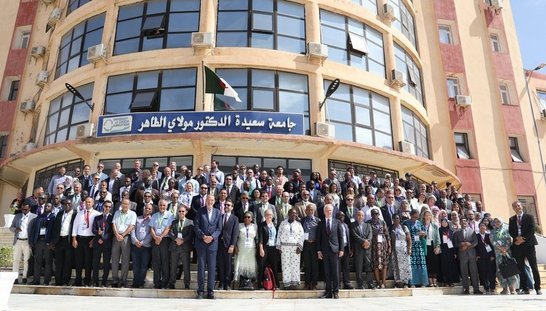
The 4th Africa-UniNet General Assembly took place from 28 to 30 September 2026 at the University of Saida Dr Moulay Tahar in Algeria.
Bringing together around 150 participants from 15 countries and a variety of universities and research institutions, the event provided a vibrant platform for academic exchange, new partnerships and discussions on the future of Africa–Austria research cooperation.
We are grateful to University of Saida Dr Moulay Tahar, Algeria for hosting the meeting.
Welcome Address
The participants of the 4th General Assembly meeting were officially welcomed by the Rector of the University of Saida, Tebboune Fethallah Ouahbi; the Governor of Saida Province; Austria’s Ambassador to Algeria, Wolfgang Spadinger; Africa-UniNet President Hubert Hasenauer; OeAD Managing Director Jakob Calice and by Algeria’s Minister of Higher Education and Scientific Research, Kamel Bidari.
While not present in person, Austria’s Federal Minister for Women, Science and Research, Eva-Maria Holzleitner sent her video message to the General Assembly expressing her appreciation of the Africa-UniNet and highlighting the importance of the network and its shared values such as freedom of research, gender equality, international partnership, scientific exchange on an equal footing and a shared determination to address global challenges.
Keynote Address
The keynote address “Translating Science into Practice: Key Stakeholders’ Agendas within the Science-Policy Interface” was delivered by Paul T. Yillia from Sierra Leone. Drawing on the relationship between science, policy and practice, he emphasised that research and scientific evidence provide an essential basis for informed decision-making. He stressed that policy and practice should be guided by evidence rather than assumptions, highlighting the importance of translating research findings into practical action. In this context, he underlined the role of researchers and scientific institutions in contributing evidence that can inform policy and address real-world challenges.
Noureddine Halla, Vice-Rector of External Relations of University of Saida, provided a brief introduction to the Algerian higher education system.
Plenary Session 1: Science Diplomacy and Sustainable Partnerships
The first Plenary Session, chaired by Belachew Gebrewold (MCI Management Center Innsbruck, Austria), brought together four distinguished presenters, each offering unique perspectives on the intersection of science, policy, and partnership.
The plenary session concluded with an engaging discussion, where participants raised questions about science diplomacy, global power dynamics, and the transition from scholarship to leadership. The dialogue reinforced the importance of cooperation, rational discourse, and the role of academic networks in easing conflict and managing existential risks.
Veronika Wittmann (Johannes Kepler University Linz, Austria) opened the session by exploring science diplomacy from a safety perspective. She underscored the growing complexity of global challenges - ranging from pandemics and climate change to loss of biodiversity and transnational terrorism - and the necessity for international cooperation. Professor Wittmann highlighted three key features of these challenges: their transnational nature, the inability of any single state to address them alone, and the need for genuine scientific imagination. She described science as a global public good, a form of soft power, and a problem-solving expertise, advocating for science diplomacy as a means to peacefully manage shared futures amid polycrisis and anti-science populism. Her presentation called for unity among scientists to protect global values and promote cross-border cooperation, placing human security at the centre of scientific efforts.
Mounya Belhocine (Université de Bejaia, Algeria) presented the SALDAE project, which aims to facilitate academic cooperation and internationalisation among Algerian universities. She outlined the project’s objectives: building structures for internationalisation, sharing good practices, modernising cooperation management, and strengthening international relations offices. Belhocine emphasised the importance of partnerships between equals, institutional team effort, and the impact of student mobility. The project has enabled the creation of national and international networks, supported the training of staff, and fostered sustainable practices that continue beyond the project’s lifespan. She concluded by highlighting the transformative effect of scholarships, which not only provide academic opportunities but also cultivate future leaders and long-term partnerships.
Benedict Mutua (Technical University of Kenya) discussed the journey from scholarship to leadership, stressing the importance of sustainability in academic mobility. He argued that the true value of scholarships lies not just in individual achievement, but in the multiplier effect - where scholars become leaders who drive institutional capacity, research innovation, and sustainable partnerships. Mutua called for the integration of successful cooperation into institutional systems, scaling up solutions to inform communities, and fostering trust and ownership. He concluded with a call to action: connect, collaborate, innovate, and impact - transforming partnerships into mutual growth and global cooperation.
Julia Lichtkoppler (OeAD, Austria) provided an overview of OeAD programmes and available funding opportunities, and focused on the impact of collaborative projects. She highlighted Africa-UniNet and its reach across 18 African countries, with over 110 projects completed or underway, supported by the Austrian Federal Ministry of Women, Science and Research. Lichtkoppler emphasised the diversity of disciplines covered, the importance of institutionalising collaboration, and the need to make project results visible and transferable. She encouraged participants to explore new ideas, evaluate project impact, and sustain long-term partnerships that lead to societal transformation and a new vision of hope.
Institutional Exchange Fair and Poster Exhibition
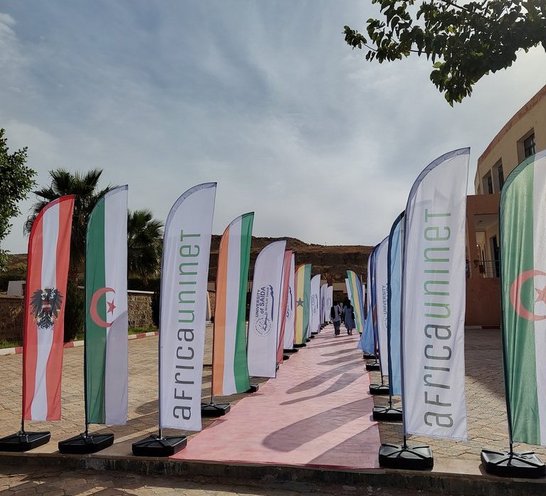
Following the first Plenary Session, attendees were invited to the Institutional Exchange Fair and Poster Exhibition set up in the Library. This interactive marketplace provided a platform for universities to showcase their profiles, research achievements, and ongoing projects. Delegates from African and Austrian institutions mingled, exchanged ideas, and forged new collaborations, all while enjoying coffee and informal conversation. The poster exhibition featured highlights of completed and currently active Africa-UniNet projects, offering visual insights into the network’s scientific accomplishments, as well as initiatives by the University of Saida.
The Monday afternoon sessions exemplified the spirit of Africa-UniNet: fostering trust, open knowledge, and sustainable partnerships through science diplomacy and academic mobility. The lively discussions and collaborative activities set the stage for continued engagement, innovation, and impact, as participants prepared to delve deeper into research and practice in the days ahead.
Plenary Session 2: Open Knowledge and Innovation in Higher Education and Research
The second day of the Africa-UniNet General Assembly opened with a lively atmosphere, as delegates gathered for the second plenary session, moderated by Deborah Odejimi (Igbinedion University, Nigeria).
Karim Djouani (CNLL Member, Algeria) began the session by outlining the vision and achievements of the National Commission for Free and Open-Source Software. He emphasised the transformative potential of open-source solutions in higher education, research, and public services. Djouani described Algeria’s journey from the early adoption of open-source software in 2001 to the establishment of a robust system supporting digital innovation. He highlighted ongoing collaborations with South Africa and Tunisia, the creation of a virtual African centre of excellence in high-tech and modelling, and the importance of adapting open-source tools to local languages and contexts. The presentation underscored the need for technical capacity, cross-border cooperation, and a long-term vision for digital transformation across Africa.
Andreas Rauber (TU Wien, Austria) followed with an insightful exploration of AI-ready data management. He traced the evolution of research data handling - from fragmented, researcher-led practices to institutionally supported, policy-driven frameworks. Rauber explained the critical role of centralised repositories, open-source tools, and machine-actionable data management plans in ensuring data quality, security, and reusability. He stressed that trustworthy data is essential for reproducible science, and that institutional support, legal frameworks, and technical infrastructure are key to sustaining excellence in research. Rauber’s presentation highlighted the increasing complexity of research workflows and the necessity of building trust through robust data governance.
Kwabena Sarfo Sarfo-Kantankah (University of Cape Coast, Ghana) offered a compelling perspective on collaborative innovation. He argued that the future of higher education is networked, advocating for open access, open collaboration, and open innovation. Sarfo-Kantankah described the University of Cape Coast’s success in international rankings, attributing it to research excellence, institutional support, and global connectivity. He called for partnerships based on reciprocity and co-creation, moving away from extractive relationships towards joint agenda-setting and shared ownership. His vision emphasised the importance of digital infrastructure, mobility, and empowering young researchers as active co-creators of knowledge. The presentation concluded with a call to build enduring partnerships and transform African universities from the periphery to the centre of global research.
Yassine Benzai (University of Saida) presented Algeria’s ambitious shift towards entrepreneurial universities. He detailed the implementation of ministerial decree 1275, which allows master’s and PhD students to develop innovative graduation projects in place of traditional dissertations. Benzai described the creation of digital platforms, business incubators, entrepreneurship centres, Fab Labs, and tech innovation centres, all designed to support student-led innovation and patenting. He highlighted the introduction of a legal framework for intellectual property, which incentivises inventors by allocating 80% of generated income directly to them and 20% to the university. Benzai noted the rapid increase in patent applications and the emergence of university-controlled subsidiaries and venture capital initiatives, positioning Algerian universities as independent economic actors. Despite these advances, he acknowledged ongoing challenges, particularly the need to foster an entrepreneurial culture among students and adapt curricula to support innovation.
Before breaking for parallel sessions, Hubert Hasenauer (President of Africa-UniNet) and Julia Lichtkoppler (OeAD) led a heartfelt moment of appreciation, thanking the University of Saida, the organising team, and all contributors for their dedication and hospitality. Gifts and applause were exchanged, reflecting the collaborative spirit and mutual respect that underpin Africa-UniNet’s mission.
Parallel Sessions
Parallel Session 1, “Shaping Sustainable Spaces and Environments” was moderated by Zipporah Gichana (Kisii University, Kenya) and brought together researchers and practitioners from across Africa and Europe to explore innovative approaches to environmental sustainability, urban development, and ecosystem health. The session was marked by lively presentations, technical challenges, and insightful exchanges, all underscoring the importance of collaborative research and locally adapted solutions. Parallel Session 2, "Shaping Sustainable Futures through Health and Technology" was guided by Heidrun Mörtl (Medical University of Graz, Austria) and explored how research in health, technology, energy, and food systems addresses societal challenges. The presentations highlighted approaches that improve health and well-being, advance sustainable technologies, and support resilient communities.
Speakers of the Sessions:
- Sharif Abuelmagd (Suez University, Egypt): Harnessing Ensemble Machine Learning for Evapotranspiration Prediction Under Climate Stress: A Case Study from Semi-Arid Algeria.
- Mary Terese Kaggwa (Kyambogo University, Uganda): Mercury Contamination and Biochar-Based Biosorption Potential in Artisanal and Small-Scale Gold Mining in Uganda
- Daniel Mengistu (Bahir Dar University): Integrating Remote Sensing and In Situ Data for Wetland Ecosystem Health Assessment within the Pressure–State–Response (PSR) Framework in Lake Tana Biosphere Reserve (LTBR), Ethiopia
- Baerbel Mueller (University of Applied Arts Vienna, Austria): Co-Habitation, Urban Ecologies, and Spatial Practice in Tamale, Ghana
- Marifa Ali Mwakumanya (Pwani University, Kenya): A review of built environments and urban spaces frameworks for resilient urban development in Mombasa, Kenya.
- Astrid Erber (Medical University of Vienna, Austria): Engaging Patients in Drug Development for Leishmaniasis
- Olusola Abiola Ladokun (Lead City University, Nigeria): Fermentation as a Tool for Nutritional Sustainability: Microbiological and Chemical Insights from Nigerian Traditional Foods
- Christoph Sumereder (FH Joanneum University of Applied Sciences, Austria): Sustainable Energy is More than Only a Study Program.
- Leboli Zak Thamae (National University of Lesotho): Shaping Sustainable Futures through Innovation: Pilot Community-Owned Renewable Energy Mini-Grids in Rural Lesotho
- Mihai Irimia Vladu (Johannes Kepler University Linz, Austria): The Avenue to Green in Organic Electronics
Africa-UniNet General Assembly
The formal General Assembly meeting focused on the network’s governance and future development. Three new universities from Egypt, Kenya and Ghana were welcomed to the network. The assembly also approved changes to the governance structure and the composition of the Africa-UniNet Board, strengthening regional representation through an expanded board with members from both Africa and Austria.
Board elections subsequently took place, with candidates representing Austria and different African regions. The eight representatives elected into the Board are: Anke Bockreis (University of Innsbruck, Austria), Astrid Erber (Medical University of Vienna, Austria), Belachew Gebrewold (Management Center Innsbruck, Austria), Ali-Maged Gharieb (Northern Africa, Suez University, Egypt), Nzula Kitaka (Eastern Africa, Egerton University, Kenya), Andreas Melcher (BOKU University, Austria), June-Rose Phoshoko (Southern Africa, University of Pretoria, South Africa), Courage Kosi Setsoafia Saba (Western Africa, University for Development Studies, Ghana). The newly elected Board will guide the network through its next phase, beginning in the coming year, with a continued focus on equal partnership, African ownership and closer cooperation between academic institutions.
The General Assembly also marked an important moment of transition. After seven years of leadership, Professor Hubert Hasenauer announced his departure as President of Africa-UniNet. The new president as of 2027 is Belachew Gebrewold (Management Center Innsbruck, Austria) and June-Rose Phoshoko (University of Pretoria, South Africa) will serve as vice-president.
Looking ahead, participants were encouraged to make use of the current Africa-UniNet Call for project proposals and the network’s matchmaking platform to develop new collaborations. The next General Assembly is scheduled to take place in Austria in 2028. The 4th Africa-UniNet General Assembly closed with a strong sense of community and optimism for the future, reaffirming the network’s commitment to equal, sustainable and impactful cooperation between African and Austrian universities and research institutions.
Complementary Programme
The University of Saida, the city of Saida, and the people of Algeria extended an exceptionally warm and generous welcome to the participants of the General Assembly. This hospitality was reflected not only in the excellent organisation of this major event, but also, and particularly, in its accompanying social and cultural programme.
Welcome Reception
By the evening of Sunday, 27 September, participants from 14 different African countries and Austria had arrived in the city of Saida and gathered for the registration and welcome reception. The reception took place at the city’s largest hotel, providing the perfect opportunity to meet fellow participants, reconnect with familiar faces, and establish new contacts in a warm and welcoming atmosphere.
University Tour
The first day of the General Assembly began with a guided tour of the university campus. Participants visited a laboratory, an AI testing lab, and several other specialised facilities at the University of Saida. This offered international guests invaluable insight into the host institution, its research infrastructure, and its key areas of research. It also provided an excellent opportunity to get to know the Algerian university and its academic community.
Algerian Hospitality and Cuisine
During coffee and lunch breaks, participants were treated to a selection of Algerian delicacies. These informal moments provided ample opportunities for lively exchanges between researchers and international office staff from across the network’s member countries and institutions.
The evening dinners were particularly memorable, combining excellent organisation with musical performances and a rich cultural programme. In an authentic and welcoming setting, participants were able to reflect on the day’s experiences, exchange ideas on the topics discussed, and continue conversations and debates over dinner. The evenings offered a wonderful opportunity to deepen professional connections while enjoying further culinary specialities from Algeria.